Showing posts with label Women and Philosophy Project. Show all posts
Showing posts with label Women and Philosophy Project. Show all posts
Wednesday, May 1, 2013
Agora (2009) A Film About Hypatia of Alexandria
Browsing around the internet for films concerning philosophy and women, I came across a movie about Hypatia of Alexandria. The film is called Agora (2009) and directed by Alejandro Amenábar. It is a dramatized and a romanticized version of Hypatia's life though; concerning a slave and a student who both fall in love with Hypatia who is disinterested, and Alexandria (the city) is dealing with the rise of Chrisianity affecting its people and culture. I think it is really amazing to find that someone created a film about a woman philosopher, especially one who existed so long ago.

Thursday, April 4, 2013
Gerda Walther

Summary
Gerda Walther (1897-1977) was born in her father's tuberculosis sanitorium near Offenburg, Germany. After the death of her mother, Ragnhild Bajer, in 1902 and her father's marriage to her aunt, Sigrun Bajer, Walther's childhood was said to be a little strained. Nevertheless, her father's Marxist/Socialist inclinations allowed her the privilege of an early political education in Marxism from various influential figures who often came to visit. She enrolled in the University of Munich in 1916 determined to become a socialist agitator.Gerda's educational path was greatly influenced by her second-semester Introduction to Psychology course taught by Alexander Pfander, and his Introduction to Philosophy course the following semester. It was there she learned of Edmund Husserl (who worked closely with Edith Stein in Freiburg im Breisgau) and was determined to work with him. Although initially Husserl refused to work with Walther, during her first semester with Stein, she was permitted to enroll in Husserl's courses. Both Stein and Husserl considered Gerda to be a fiery and bright individual. She was one of less than five female students working under Husserl. Nevertheless, desiring to complete her doctoral dissertation more to her own tastes, Walther returned to Munich to work with Pfander on her dissertation, Zur Ontologie der Sozialen Gemeinschaften (On the Ontology of Social Communities, 1919). Her dissertation combined phenomenology with Marxist philosophy on the nature of community, understanding humans as essentially socialized beings. She received her Ph.D. summa cum laude and was permitted to become a professor (not all women were permitted this privilege).
While her focus had primarily been set on political activism and socialism, Walther's philosophical interests radically shifted due to a mystical experience she underwent while on a train in 1918. She was overcome with a supernatural experience of light, warmth and goodness. After receiving her Ph.D. she began focusing on the phenomenology of mysticism and parapsychology. Although Walther was permitted to become a professor (unlike Stein and other women philosophers of this time and prior), she was unable to support herself due to the struggling German economy and for the remainder of her life worked part-time jobs when she could find work and wrote on her own. One of the many jobs she accepted was as a stenographer for the state mental health hospital in Emmendingen working with schizophrenic patients. While her work was menial and frustrating, she was able to consider the likeness of mental illness to mystic experiences (as many claimed mysticism was just that).
Although she was fired for condescendingly describing the mental abilities of the medical staff, she received an offer to work with Dr. Albert Freierr von Schrenk-Notzing conducting parapsychological research. Prior to this opportunity, Walther had spent considerable time learning studying and practicing astrology, mysticism, seances, and other "occult" things, so she was a perfect fit for the job. Schrenk-Notzing attempted to apply the scientific method to study such experiences ad telekinesis and materialization, often performing seances and working with mediums. Unfortunately Schrenk died unexpectedly and Walther was again out of work.
Walther's work on mysticism included three editions of her book, Phänomenologie der Mystik (Phenomenology of Mysticism) in which she defended the mystical experience my providing a phenomenological account of mystical (and similar other experiences) shared from around the world, including her own. She argued that simply because not all had access to such experiences does not prove them irrational as not all can understand and experience complex mathematics and yet we except them as legitimate. She defended the mystical experience as a real and perfect form of spiritual data provided from the divine. Those who deny mysticism are not approaching the subject with "the open mind with which the philosopher should approach any subject." (McAllister, 1995). Her later works also included an explanation of how occult practices and parapsychology relate to the mystic experience and external perception of the real world.
After working with Schrenk-Notzing, Walther supported herself doing freelance writing for journals on parapsychology and psychic research, but in 1933 when the Third Reich took power, publications in parapsychology were banned and she faced questioning by the Gustapo. Eventually she was forced into national service censoring international mail (since she knew English, French, Italian, Dutch and Danish), but would occasionally send penciled-in notes warnings and notes to people who's correspondence she encountered more regularly. Close to the end of her life, after the war had ended and her financial and physical well-being were nearly depleted, she was helping to support a meeting of German Women philosopher, but had neither the funds nor strength to attend. Neverthless, she remained actively ingaged in correspondence with various philosophers up until the week of her death in 1977. Her autobiography, Zum anderen Ufer (1960), remains in school libraries across Germany because it provides insight into German life.
Personal Response
I initially thought that I wouldn't like this section on Gerda Walther, but after reading the article, I found her to be a fascinating individual. She was fiery, passionate and determined. Gerda earned the chance to work with Husserl despite his initial refusal, then she refused to work with him as a dissertation adviser (though many would kill for the chance) because she wanted the freedom to write her own ideas rather than be directed to write an extension of his. After her mystical experience, she supported and defended a view in philosophy that was utterly rejected and criticized by most. She even faced rejection from most of the philosophical community for her interests in telepathy, clairvoyance and ESP. Finally, I thought it was fascinating that she was unable to teach and participate in the realm of academic philosophy because of her economic situation (apparently professors received menial tuition from students themselves rather than payment from the universities), but persisted in doing her own research and writing throughout her life. She even published work under a pseudonym when she was forbidden to publish an article through a Jewish journal.Gerda Walther was an inspiring person. Her ideas were unique and interesting, and her fire seems to have stayed with her through the end of her life. I am more interested in her earlier work on communities due to my own interest, but I find her work on mysticism to be very interesting. It seems that she believed (and a small majority may have agreed) that mysticism and parapsychology are real, scientific fields and that the experiences produced from such fields are in a category of spiritual data that are as legitimate as the epistemic conception of sense data, etc. I also thought it was interesting that Walther's work was often more written for the average reader since she was primarily excluded from philosophical communities.
Source
Chapter 8 "Gerda Walther" by Linda Lopez McAlister from A History of Women Philosophers Volume IV: Contemporary Women Philosophers 1900-Today, by Mary Ellen WaitheAyn Rand
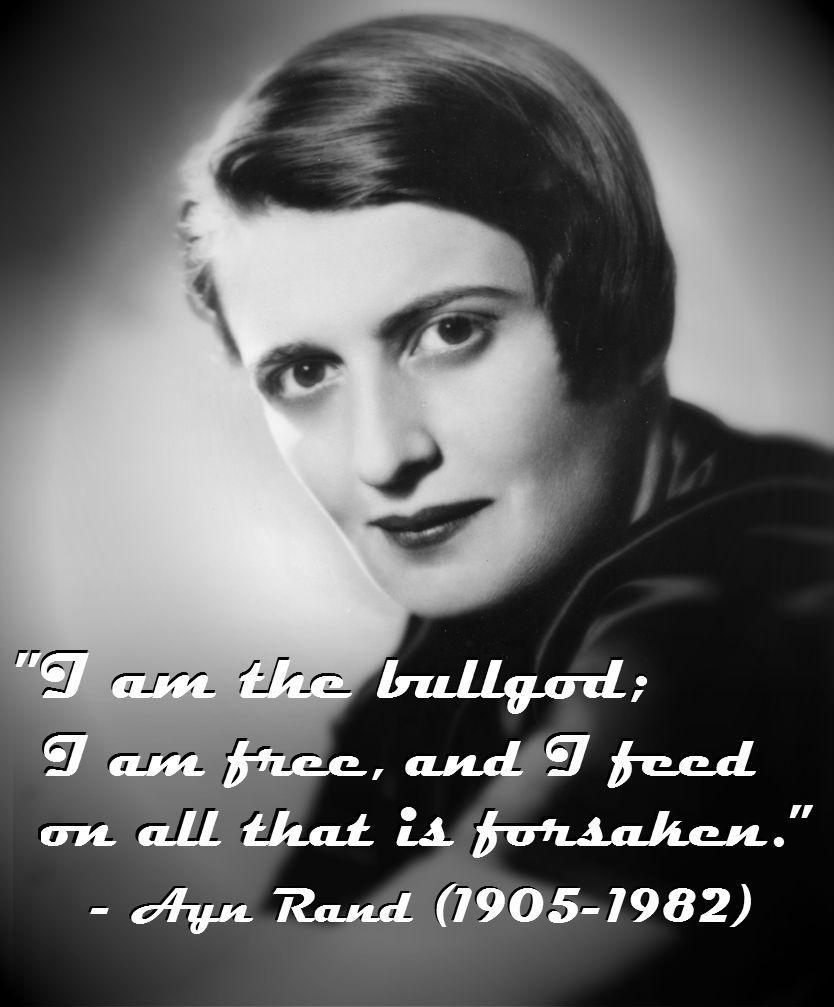
Summary
Ayn Rand (1905-1982) garnered extensive admiration and
contempt even through death. Her dream was to be a writer, but more than that,
a revolutionary. She realized her dream of becoming a writer, but it is
controversial as to whether or not to call her a philosopher . Rand was born
Alice Rosenbaum on 2 February 1905 in St. Petersburg, Russia to a chemist
father and a domineering mother. From a young age, she was a bright child who
learned to read before beginning school and early on saw problems with
Communism. Rand believed living with the state and for the state were troubling
and wrong.
Rand stated that her method of thinking changed at the age of 12 to “thinking
in principles.” It was noted that Ayn Rand could break down complex ideas into
easily comprehensible parts. She discovered Victor Hugo’s works at this time
and became fascinated with his sense of life. During her last two years of high
school, Rand took classes about the American government and the Declaration of
Independence. Attending the University of Petrograd, Rand obtained a degree in
history and was introduced to the philosophy of Nietzsche. She admired his
reverence of the heroic man, individualism, and contempt of altruism, but she
was bothered with his defense of psychological determinism, ambiguous use of
the issue of power, and position of anti-reason.
After
her studies in university, the Rosenbaum family immigrated to America in 1926.
In America, Rand changed her name from Alice to Ayn (rhyming with “mine”) after
a Finnish writer whom she had not read. (She liked the name.) Interestingly
enough, Rand set off to Hollywood for a career in screenwriting in mid 1926. In
1929, she married Frank O’Connor who shared the same values. When they had only
$700 to their names, Rand decided to work on the presidential campaign of Wendell
Wilkie, whom she saw as a candidate who embraced her philosophy. During these
political activities, Rand met many conservatives, including Isabel “Pat”
Paterson, with whom she came to form her first and last important friendship
with a contemporary. Paterson and Rand shared a teacher/student relationship
despite their many differences such as opposing views on religion; Paterson
used an element of religion in her writings while Rand saw religion as the
first enemy to the ability to think. At this time, Rand’s individualistic
thought became apparent in her personality traits of self-responsibility,
contempt at humor and reliance on others, and ego.
In 1950, a young man named Nathan Blumenthal wrote a letter
to Ayn Rand with questions about her novel, The Fountainhead. He was to
be responsible for the dispersion of her philosophy. Blumenthal influenced her
writing and introduced Rand to Barbara Weidman, who will become her closest
confidante. Blumenthal, Weidman, and other young intellectuals would become
known as “The Collective,” chosen for their antithetical nature to Rand’s
philosophy and whom Ayn Rand herself affectionately called “the children” or “
the class of ’43.” The group would popularize Rand’s Objectivist philosophy.
Like with most relationships between men and women, attraction occurs, so it
was not unlikely for Rand and Blumenthal (who was known as Branden), to conduct
an affair with each other. When they both confronted their spouses for consent
to the affair, Rand argued that given her own nature and that of Branden, logically
they had to love each other; rationality and logic made it acceptable
for Frank and Barbara to accept the relationship and not be shocked. Blumenthal
was the epitome of her heroic characters in looks, epistemology, and ethics.
The relationship however, did not last; when Blumenthal refused to continue
their sexual relationship, Rand cut all ties with him. Rand gave the position
of her intellectual heir to Leonard Peikoff, further driving the separation
between Blumenthal and herself.
Rand’s final public talk was held in 1981 at the convention
of the National Committee for Monetary Reform in New Orleans. The following
year in March, Rand died after never recovering from a respiratory illness she
contracted in New Orleans during her last public talk.
Ayn Rand wrote literary works that were immersed with her
philosophy. Some of her earlier works had literary themes that foreshadowed her
philosophy, such as the intelligent woman worshipping the man who brings out
the best in her, or the individual who does not look back. Her later works,
including The Fountainhead (1943), We The Living (1936), Atlas
Shrugged (1957), The Virtue of Selfishness (1964), For the New
Intellectual: The Philosophy of Ayn Rand (1961), and countless others,
would bring forth her Objectivist philosophy. Atlas Shrugged (1957) was
seen by Rand’s followers and Rand herself as her true masterpiece. It was
dubbed the Objectivist “bible.” The book was philosophy and literature, the
culmination of Rand’s philosophical theory. The heroes are men of self-interest
while the villains are enemies of individualism and free enterprise. The world
destroys itself of its socialist society in order to rebuild itself. In her
philosophy, Rand sees man as a heroic being whose own happiness is the moral
purpose of his life. Productive achievements are man’s noblest activities and
reason is his only absolute. She credited Aristotle for his logic and
development of metaphysics of objective reality. Yet, she condemned Kant for
the return of mysticism and physical force and indicts Descartes for denying
the existence of an objective reality.
She saw the return of the Witch Doctor and Attila as the
moral bankruptcy of culture. The Witch Doctor, relying on faith, and Attila,
relying on physical force, oppressed people’s ability to reason. An
intellectual’s job, according to Rand, was to provide a rational morality for
the businessmen. She repudiated collectivism, finding Russian communism disturbing
and troubling for the individual, while she praised and looked to a radical
idea of capitalism, the merging of the intellectual and the businessman as “a
free man and a free market are corollaries.” She favored selfishness to
altruism, the former being a virtue because it complies with the primary goal
of an organism to maintain its life, its self-interest. Rand said a new
intellectual needs to rise, one who is guided by reason alone, values “self”
above all else, and refuses to give in to faith or to force.
In the literary academic world, Ayn Rand was seen as a
philosopher but in academic philosophers rejected her Objectivist philosophy.
In the end, there is no denying that she created great stir in the public world,
but also among intellectuals and despite the reluctance of many to call her a
philosopher.

Personal Response
I first came across Ayn Rand when the principal of my high school said her favorite book, and the one she lives by, was The Fountainhead. Curious, I sought out the book and quickly became immersed in the life and works of Ayn Rand. Reading the whole book at least two times, I found it troubling that this was the book by which she lived her life . More troubling was trying to understand whether my principal saw the main character as the protagonist or antagonist because her way of thinking lent towards the altruistic thought Rand denied and put down. Rand makes it known that being selfless is a vice, something that will cause great harm to an individual. But if we were to only care for our own feelings, own wants, and own needs, and ourselves, how could we live in a social society? I could see where people are taken aback with Rand’s philosophy; they could not really exist in a world where people are social creatures and could not truly be individualistic. I do not entirely agree with her ethics about selfishness as a virtue because it makes humans devoid of connection and emotion. My worry is if every person were acting out of own personal self-interest, how would the world function, if at all? Things might become stagnant as people will not care about others and the world might fall apart as desires/wants grow tremendously. It is a very radical theory and the characters she created are so unbelievable so her philosophy seems unreasonable to people.
Whether she was a philosopher or not, Ayn Rand was a woman intellectual,
strong, and unafraid to voice her thoughts to the public. However, her views on
women were often questioned, as they did not really portray women as equal with
men. For Rand, the ideal woman finds pleasure in surrendering to the heroic man
she worshipped. I do not think that is a strong image of a woman; it’s
submissive. If Rand places such emphasis on self-interest and the individual, why
differentiate between male and female? Why could not a woman be heroic like the
heroic man? I see how her views on women were questioned as they are not
consistent with her other set of views. The woman’s surrender is submissive and
it’s almost like she is on a lower level than the man. But is that Rand’s true
thought? I am not sure because she does not have any extensive work on the role
and status of women in society.
What is the most fascinating is the fact that despite Ayn
Rand not really seen as a philosopher, there were many people who followed and
believed in her Objectivist philosophy. She garnered extensive discussion,
debate, and controversy with her thought that even if her philosophy was
rejected, it was as influential as other philosophers. I had not seen her as a
philosopher when I first read her work, but more of a literary writer. Yet, her
philosophy was deeply embedded in her characters, plot, and the whole story.
How can one area of academia see her as a philosopher while another denies that
title? That bodes the question how are we defining philosophy? What, if there
is one, a collective agreement to defining philosophers as Aristotle and
Descartes were one?
Source
Chapter 9. "Ayn Rand (1905-1982)" by Jenny A. Heyl in A History of Women Philosophers: Contemporary Women Philosophers, 1900-Today by Mary Ellen WaitheWednesday, April 3, 2013
Simone de Beauvoir

Summary
Simone de Beauvoir, a French writer, is perhaps best known for authoring The Second Sex (1949), a book detailing the treatment of women throughout history. She is not only identified as a writer but also a feminist, existential philosopher, and social theorist. Her works, over twenty separate titles, are considered widely influential, but she is generally referenced as an important feminist theorist rather than a philosopher. Her relationship with Jean-Paul Sartre has also contributed to her fame, but her work extended far beyond her association with Sartre. She made major contributions to philosophy, literature, and feminism.Simone was born in Paris in 1908 to Francoise Brasseur de Beauvoir and Georges de Beauvoir. She studied philosophy at the University of Paris, eventually teaching upon completion of her agrégation. In 1944 Simone became a full-time writer. She traveled the world and took part in various political demonstrations. She died in 1986 at the age of 78.

 Personal Response
I would have loved to hear more about Simone's life. The biography was on the smaller side; this allowed for a more detailed description of her works and philosophy. And considering that we actually have access to her original work, that was refreshing. Many of the figures we've read about this semester had a known body of work. Often, especially among the earlier philosophers, all we had was the testimony of others that certain texts existed or that the woman in question held a certain philosophical stance. I did a little extra research, and I was surprised to see how incredibly interesting and exciting Simone's biography is. I would have loved to see more about her education as well as her relationship with Sartre. (Apparently, Simone was considered brilliant by her peers. One lecture I found suggested that Sartre beat her in an examination only due to there interaction.) So while I understand the need to limit the biography in this book, I also would be interested in reading a more detailed description of her life.
I was struck by Simone's interest in writing from her own personal experience. Apparently The Second Sex began as an examination of what it meant to Simone to be a woman. She seemed to be interested in conceptions of "self" as a philosophical concept and "herself" as a subjective person with experiences and things to say. Unlike many philosophers I've read, Simone seemed to be very interested in her own experience. She did not claim to be "objectively" impartial. Instead she was driven by the things that impacted her life.
It saddened me to hear that even Simone was overshadowed by Sartre. Apparently she viewed herself as a lesser philosopher, and their works, much like Émilie and Voltaire, were heavily influenced on both sides. Though such a relationship of two intellectuals would probably be greatly beneficial to both, it seems troubling when considering Sartre receives more attention. His works and contributions are often seen on a college syllabus, whereas Simone is not nearly as iconic.
Reading either Simone's autobiography and/or a biography would be incredibly interesting. As long and detailed as this chapter was, due to its expansive coverage, it left me feeling like there was much more to Simone and her work then could be reasonably summarized in twenty-plus pages. One of the highlights in this chapter was getting to read so many quotes from Simone herself. Her writing is elegant and clear. And I even recognized several of her arguments or issues from various philosophy classes I've taken. She was clearly well educated in many philosophical areas, but she was equally as clearly thinking about the knowledge she received through her education. Based on outside research, it looks like Simone's father, like many of the other figures we've discussed, also encouraged her education and intellectual pursuits.
In the end, I think this chapter made me want to know more about Simone. Her interest in writing, especially fiction, caught my attention especially due to my own interest in that area. It reminded me of Murasaki Shikibu's use of literature to convey philosophy. I hope to have the opportunity to learn more about Simone de Beauvoir in the future.
Source
Chapter 12 "Simone de Beauvoir (1908-1986)" by Jeffner Allen and Jo-Ann Pilardi in A History of Women Philosophers: Contemporary Women Philosophers, 1900-Today by Mary Ellen WaitheThursday, March 21, 2013
Émilie du Châtelet

Summary
Gabrielle Émilie le Tonnelier de Bretuil du Châtelet-Lomont (1706-1749)
was born into an aristocratic family (her father served in the court of the
king) and as such, she received an excellent childhood education. By age 12,
she had already fluently reading, speaking and writing in French, English,
Italian, Spanish and German and could translate from both Greek and Latin. Nevertheless,
as most women of the time, she was excluded from receiving any form of
upper-level education. The Sorbonne and the “cafes” were primary sources of
upper-level education but women were not permitted in such places. But Émilie
was determined. She once entered a café with a friend, Maupertuis, and
proceeded to join in the conversation the males at the table until she was
firmly instructed to leave by café management. The following day she returned,
dressed in “drag” and was permitted to remain at the table (even though it was
clear she was a woman).
 |
| Voltaire |
At the age
of 19, Émilie married a military leader, the Marquis Floret-Claude du Châtelet-Lomont.
The biography speaks little of her marriage to her husband except that she bore
him three children (one who died in infancy) and had numerous affairs with
various tutors and influential male members of society – each who played an
influential role in her education and shaping her influence in philosophy. Likely
the most influential lover in Émilie’s life was Voltaire. She and Voltaire
moved into one of her husband’s abandoned estates and remodeled it into a
high-class, top-notch library and laboratory in which the two studied Newton,
Locke, Leibnitz, and many others. Émilie is known as an experimental physicist,
replicating many of Newton’s experiments as well as conducting her own. She also
dabbled in areas of ethics, philosophy of religion, philosophy of language, philosophy of science, metaphysics, wrote a number of books and essays, including her
translation of Newton’s Principia and
a notable essay on the nature of fire. She also collaborated extensively with
Voltaire on many of their works to the extent that it is unclear which ideas
belong to which author in many of their joint works.
Émilie
gained wide recognition first as an experimental physicist and philosophers of
science in her contribution to Voltaire’s work, Éléments de la Philosophie du Neuton, earning her the name “Lady
Newton,” but also gained a great reputation as a metaphysician in her essays on
optics, color, and fire, but more so from her Institutions de Physique and her translation and commentary on Principes Mathématiques de la Philosophie Naturelle (the first
French translation and commentary on Newton’s Principia). Émilie initially considered herself a pure Newtonian,
convinced that Newton’s works were an accurate depiction of what was actually
happening in the universe. While she was convinced the Newton gave and accurate
depiction of how the universe worked, she felt he failed to explain why it
worked as such – Descartes held a better theory of metaphysics. She felt that
Newton’s physics described an omnipotent, but not omniscient God and it claimed
that action was predetermined. Predetermined action would indicate that there could
be no free human action and no free will. If there is no free will, there is no
virtue and vice and, according to her familiarity with Mandeville’s account of virtue and vice, she believed that without vice there is no need for political
society and also no need for the spiritual reformations taking place that
accounted for personal salvation, etc.
Émilie felt
that without providing the metaphysical underpinnings for Newton’s physics,
French society would never accept Newton and all he had to contribute. She was
shortly after introduced to the works of Leibniz and she began to see how
Leibniz metaphysics could support Newton. Her Institutions de Physique explains and defends the relationship
between Newtonian physics and Leibnizian metaphysics. She combined Leibnizian
ontology with Newtonian atomism, using Leibniz monadology to understand true
substances. She discussed the principle of sufficient reason to explain why possible
events actually occur and to reestablish the predictability of science (such
that it is not merely a whim in the mind of God that can change when God
changes his mind, etc.). She also used Leibniz Law of Noncontradiction to
explain how humans can still have free will and his principle of sufficient
reason to explain why there are beings with free will. As such, she was
seemingly able to defend Newtonianism while simultaneously preserving notions
of the nature and will of God, as well as the nature and will of humans and
their interaction with God. She preserved human initiative and free will as
opposed to accepting humans as just cogs in the wheel of a perfectly designed
machine (as Newton held).
While the Institutions was one of her greatest
works, many pure Newtonians rejected the combination of Newtonian and
Leibnizian ideas (Voltaire himself didn’t see a need for a metaphysical
defense). Nevertheless, Émelie’s greatest work, her life’s work, was her
translation of Newton’s Principia. She
desired to make Newton’s views accessible to the French people. As such, she
not only translated his work, but made some modifications of her own as well as
added commentary. But her translation held true to Newton’s original work and
she clearly indicated when she was inserting her own thoughts or corrections.
For nearly two centuries, Émilie’s translation served as the primary French
translation of this work and served as a central piece to the Enlightenment. While
working on the translation, Émilie became pregnant by a younger lover. Fearing
that she would die in childbirth, worked 20 hours a day to complete the work.
She finished, but shortly after her child was born, both died.
In conclusion,
while society still held up barriers to women receiving equal education with
men of their same rank, Émilie’s determination allowed her to have exclusive
access to private societies and the great thinkers of her day. Her aristocratic
background gave her some influence, as well as her many affairs, but she was able
to hire tutors from the Sorbonne to learn mathematics and physics, and was
privy to an exquisite library and laboratory. She became well-known, even
outside of France (Kant recognized her work and commented on an essay she had
written). In addition, she was an influential thinker in various areas of science including the scientific method, metaphysics, and explored questions of theology, existence and more.
Personal Response
From this
biography of Émilie, it is amazing how much she was able to learn and
accomplish. She seemed nearly brilliant in her ability to learn so quickly the
ideas of others, different languages and different subjects, and then to
publish so many books and essays. I also found it amazing how she was so
influential in science, an area that we consider to be primarily relegated to
men. Of course, this was the age of the Enlightenment and science was the
primary field of interest. Nevertheless, I thought it was really fascinating
that she was able to gain recognition and respect for her work, despite the
fact that women were still predominantly excluded from society. And this was
not the type of “awe” given to women of the medieval period who were seen as
prodigies, she gained legitimate respect and was sought after for conversation
and ideas on the works she published and studied.
Additionally, although Émilie was a bit promiscuous,
I wonder how much of that was her own desire, and how much was influenced by
her understanding that sex was a means to attain a better education and access
to scientific, philosophic society. A commentary from another woman suggested
that she intentionally dressed in gaudy attire to make her face appealing and
gain attention – which could mean she simply desired to have many lovers, or
she was trying to gain favor from those she thought could offer educational
benefit (so either way). Regardless, it was interesting to me that she was
never criticized or rebuked for her sexuality, but maintained a seemingly
respected reputation – which I think can shed light on the changing
(diminishing) role of Christianity and religious values, as well as speak to
her confidence and determination to do as she desired to do and accomplish her
goals.
Source
Chapter 8 "Gabrielle
Émilie le Tonnelier de Bretuil du Châtelet-Lomont" in A History of Women Philosophers: Modern Women Philosophers, 1600-1900, by Mary Ellen Waithe
Antoinette Brown Blackwell

Summary
Antoinette Blackwell (1825-1921) was an American philosopher, but was also the first woman minister to be ordained in America. Blackwell wrote six philosophical works and preached into her nineties. She was also known for being a social activist for Women's rights, the Temperance movement, and Abolition movement. Blackwell's most influential work was The Philosophy of Individuality (1893). Due to her progressive work towards women's rights and her longevity, Blackwell was able to cast a vote in the Presidential election in 1920.
Blackwell was educated at the Oberlin Theology Program, but the school refused to grant her a ministerial license. She then found the Orthodox Congregationalist Church, which ordained her in 1852. It was after this time that Blackwell began advocating for women's rights, specifically for women to have the right to have paid work outside the home and also for women to have the right to publically speak. After marrying and having seven children, two of them dying at birth, Blackwell found herself spending much more time at home and having less time to spend preach. It was in her time spent at home that Blackwell began to focus more on philosophy.
After a nervous breakdown, Blackwell left the parish. This is when she began to work extensively on metaphysics. Her first philosophical work was Studies in General Science (1875), which explained mind and matter in a God created universe. Her second work was The Philosophy of Individuality, which concentrated on harmony between the particular and the absolute. As time passed, Blackwell returned to preaching, having changed to the Unitarian Church and still publishing philosophic works. Blackwell died in 1921 peacefully in her sleep.
Blackwell believed that understanding metaphysics was the most important aspect to studying philosophy and thought that logic was going to undermine the philosophical system. Her purpose in studying metaphysics was to connect the study of nature with the process of the universe. Blackwell also believed that truth was not "abstract or complicated, but simple and self-evident." (pg. 190) Also, Blackwell focused on perception and thought that perceptions and observations were truths; that 'falsehoods' were merely misunderstandings of observation or not fully understanding connections. Through her education in theology and philosophy, her beliefs were constructed around the idea that God was a Rational Designer. Similarly, that all living things were conscious, including plants and animals. Blackwell strongly believed in immortality and that it should not only be grounded in a belief in God, but also in scientific justifications. She thought that "as nature endured surface changes while in its basic underlying structure, the atom, did not change, so human beings grow and develop while the self remains immortal." (pg. 192) Aligning with her fight for women's suffrage, she believed that sexes were equal, but that for every 'advance' in a male trait, there was also an 'advance' in female traits.
Personal Response
Antoinette Blackwell has been the most interesting woman philosopher who I have read about thus far. It is astonishing that she was the first woman preacher in America. I also find it inspiring that she spent her entire life working for the women’s suffrage movement and at the age of 96 was able to vote in a Presidential election. Having published six philosophical works on various subjects, being a preacher, a mother of five, and working well into her nineties is nothing short of amazing. To me it seems that Blackwell somewhat paved the road for the women philosophers who would soon follow her. Having made profound contributions to philosophy it is a little unsettling that her name has not come up in my education so far.Source
Chapter ? "..." by? in A History of Women Philosophers: Modern Women Philosophers, 1600-1900 by Mary Ellen WaitheWednesday, March 20, 2013
Clarisse Coignet

Summary
Clarisse Coignet (1823-1918) made a place for herself among
the dominant male peers of her time. A moral philosopher, an educator, and a
historian, Coignet held true to the notion of women being multi-taskers and
could hold more than one title. Not only was Clarisse Coignet this triple threat,
she was an active leader of La Morale indèpendante, a political and social
movement in France. The movement sought to establish morality’s independence
from science and religion. A woman mindfully aware of the world around her,
Coignet’s earliest works were in response to the reform of French educational
system and proclamation of the Republic. She defended public education in a 1856
work and delved into moral education with a textbook for secular schools
published in 1874 that garnered wide recognition and debate.
Coignet’s work as an editor with the newspaper La Morale
indèpendante helped bring to fruition her most significant philosophical
work entitled, La Morale indèpendante dans son principe et son objet.
The work published in 1869 was inspired by Kantian thought and illustrated her
position on the relation of moral philosophy and religion. Coignet discussed
the concept of individual morality that originated as a political movement in
France at the end of the 18th Century and became a social movement
in the early 1860s. The social movement of independent morality at that time
sought to bring forth a conception of morality in correspondence with the
political ideals of the French Republic. In this work, Coignet established a
view of moral science that she labeled as “the true philosophy.” She argued that
moral science is independent in its sovereign and origin in human life. Its
goal is to construct a new society and a new individual through equal rights
and reciprocal obligations. This was different and radical as it elevated human
right higher than divine right.
Coignet founded independent morality in the freedom of the
individual. Morality is an autonomous science and freedom comes from human
accomplishments and human conscience. Man is the creator of morality; he or she
is an end in himself or herself and the cause, end, and agent of his or her own
goals. For Coignet, people are responsible for their willful activity and
become moral by intervention of conscience. Religion and morality are separated
from each other but morality does not exclude religion entirely. Coignet stated
that religion is excluded from society as a political power but that religion
exists in the human soul. Her discussion on the independent morality aligned
itself with the rising discussion about women’s suffrage existing in Britain.
Independent morality sought to renew women’s dignity and change their roles in
society, being seen as ends in themselves and free to be their own persons with
rights and morals. Coignet believed education should not separate men and women
but instead should mix them together in order to improve their weaknesses.
Interestingly enough though, Coignet argued that no matter what the future for
women would be, women’s nature would remain the same which is motherhood,
producing children.
Personal Response
Unlike the previous section of women philosophers, there is
very little background information about Clarisse Coignet, only that she was
born in 1823. I searched for a history of Clarisse Coignet only to find a brief
paragraph by Dr. Bremand Nathalie from the University of Poitiers in
France. The short paragraph stated Clarisse Coignet was the niece of famous
Fourier Clarissa Hale and was a Protestant. Despite that loss of information,
there seems to be an extensive study of her philosophical work, La Morale
indèpendante dans son principe et son objet. It is clear Kant, who worked in
the same period of history, discussing duty and morality, influenced Clarisse
Coignet.
What was unexpected or, I had assumed wrongly, was that
Coignet was not fully supportive of women’s suffrage (particularly in France)
and women’s superiority. She understood or saw the limitations women have in
regards to being in position of power or great strength, as their nature is
ultimately to bear children, which makes them weak in body. I would have
thought she would be fully supportive of women’s roles, or voice more opinion
on the fact women could be something other than mothers and pursue careers with
power. If she believed that moral law is grounded in human reason and that man is
an end in himself, why would she claim that the role women still be subjected
to? If a woman is a sovereign end in herself, should she not be able to be
something other than a mother without discrimination? This seems to be a double
standard.
Women are free to be their own persons, but their nature to
be mothers hinders them from truly being their own persons. This idea still
exists; women are struggling to stay at home or work as President or CEO of a
company. The problem hasn’t resolved at all, but merely discussed and debated. At
a point in history, the independent woman was seen as the role model for all other
women to be free and true to themselves. But today, it seems like women are
struggling with, on the one hand, a strong sense of independence and, on the
other hand, a rising appreciation for motherhood.
Coignet seems to place a great deal of power and status on a
human being in regards to morality and judgment. Are not human beings flawed
creatures who can be driven by passion more often than reason? If that is the
case, I do not see morality as grounded in human reason because it could be
flawed. How can it be purely objective if morality comes from human conscience
as each person might have different views?
Sources
Chapter 10. "Clarisse Coignet" by Jennifer Allen in A History of Women Philosophers: Modern Women Philosophers, 1600-1900 by Mary Ellen Waithe
Bremand Nathalie (2009). "Clarisse Coignet (1823-1918)." The first socialism, virtual library of the University of Poitiers. http://premierssocialismes.edel.univ-poitiers.fr/index.php?id=1003.
Hypatia of Alexandria
Summary
Hypatia of Alexandria’s (370/375
A.D.-415A.D.) history is riddled with varying accounts and half-truths. Two
sources have different years for Hypatia’s birth, one sources dates her birth
between 370-375 and another at 375 A.D. Hypatia lived during the time paganism
was reaching its end and Christianity was gaining followers and power. Theon,
her father, was a teacher of mathematics and astronomy at the Museum. The
Museum was a school or more like a center of mathematics and science where
Ptolemy’s successors merged physics, mathematics, and philosophy into an
applied natural philosophy. Hypatia’s early education is still debated, as
there is no record of it. It was assumed by many that Theon taught her but he
had not trained in philosophy. Hypatia, however, was known to have taught
philosophy in Alexandria, so an inference was made that her training was
received from philosophers of the Neo-Platonic school at Alexandria. One of the
sources, Hoche, assumed that Hypatia was educated by mathematicians at the
Museum in Alexandria and by other scholars there too. She obtained the position
of a teacher after her studies at the Museum.
Being a teacher allowed Hypatia to explore and to continue
with her studies in philosophy, science, and mathematics. One of her students,
Damascius, stated she taught geometry and mathematics. Another, Hesychius,
stated she was a great astronomer like her father. One of her most significant
pupils was Synesius who was almost exclusively educated by Hypatia. From
Synesius’ letters, it has been determined that Hypatia taught the works of
Plato and Aristotle, as well as Neo-Platonism, astronomy, mechanics, and
mathematics. Hypatia taught and worked during a time where paganism and
Christianity were struggling against each other for power. It took courage and
strong intellect to teach these subjects in Alexandria.
By 404 A.D., Hyaptia was appointed head of the Neo-Platonic
school at Alexandria. Her works included a commentary on Diophantus’ Arithmeticorum,
an Astronomical Canon that formed part of her commentary on Ptolemy’s Syntaxis
Mathematica, and a commentary on the Conic Sections of Apollonius
Pergaeus. She focused more on the writings concerning metaphysics, cosmology,
and epistemology. She used philosophy to form a foundation for her intellectual
pursuit of astronomy. Through theorems and scientific theories, Hypatia worked
to answer philosophical questions of “Who are we, what is our place in the
order of things, what is the nature of god…” (Waithe, 176).
Personal Response
It is incredible to learn that a woman
could be not just a teacher but also an influential and amazing one in a time
of political, religious, and social upheaval. How much weight could be placed
in the information provided remains to be seen. Waithe seems to favor one
source above others, using Hoche’s assumptions as factual information about
Hypatia. It is troubling that the information written could possibly be false
or hold very little truth to it. Working with antiquity, it is by no means
surprising that information is limited and often full of assumptions, rather
than actual factual information. Hypatia did have students of her own and there
seemed to be references to her as a teacher of mathematics and science, but
still how much truth could be held in them? Waithe commented that some of the
sources stated Hypatia’s work had not survived and are considered to be myths.
Only for the last decade or so did Hypatia’s work come up in various searches
but it was still inconclusive whether it was truly Hypatia’s work. It would
have been amazing to know for sure whether the things described really did
happen. If so, then why have views about the roles of women in education (especially
philosophy and the “male subjects”) changed from Ancient Greece to the Middle
Ages to now? How could women be heads of a school in one period of time only to
be subjected to discrimination and put on the bottom rung a few hundred years
later?
Source
Chapter 9. "Hypatia of Alexandria" of A History of Women Philosophers: Ancient Women Philosophers 600 B.C.-500 A.D. by Mary Ellen Waithe
Tuesday, March 19, 2013
Kristina Wasa
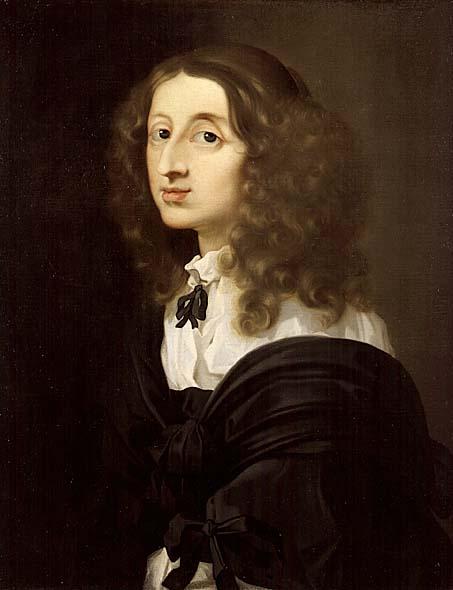
Summary
Kristina of Sweden (1626-1689) is one of history's more quirky individuals. Her life departs from the societal norms of her time, and we are privileged enough to have access to a decent amount of information about her life and work.
After having a nervous breakdown, Kristina began to take steps towards abdication. She would eventually convert to Catholicism, though her religious beliefs still remained fairly heterodoxical. Through her position of authority as the Queen of Sweden, she had seen religion used as a political means, and she continued having many doubts, including being troubled by Church dogma. Eventually she conversed with Jesuits in secret and she corresponded with Catholics as well. Kristina was committed to acting in such a way that accurately reflected her worldview, and so she was drawn to discussions about the nature of reality, good and evil, etc.. Kristina was described as being rather masculine. She would wear male clothing, pursue spheres normally reserved for male members of society, and had a deep, masculine voice. By rejecting female culture, Kristina may have viewed herself as primarily male. She never married and often spoke out against the "feminine sex."
The Queen of Sweden lived to be sixty-three, dying in 1689. In her lifetime she wrote, discussed, and studied the theory of the philosopher's stone (or alchemy), skepticism, stoicism, Catholic mysticism, and linguistics.
Personal Response
Overall, I really enjoyed reading about Kristina Wasa. She was an interesting figure who defied any expectations I might have had of her. (I like to think she was kind of quirky, though she was probably far too unorthodox to be considered simply quirky.) Based on this chapter, I gathered whoit was her father that encouraged her education. After his death, the queen then continued her education, since it was in the best interest of Sweden to have an educated leader. This reminded me of the various other women philosophers we've discussed whose education we can trace back to the father. Often the mother is not mentioned or did not support the education of the daughter.A minor pet peeve I have with the actual chapter is in the discussion of Kristina's philosophical development. Susan Akerman writes, "Matthiae with his strong unionist tendencies is responsible for Kristina's tolerant and critical perspective on religion" (26). When I read this sentence initially, I found it rather off-putting, like Kristina's perspective was not her own. I realize that Akerman may have intended to suggest that she was exposed to such concepts through Matthiae, but I dislike the assertion that they came from him alone. Based on what Kristina did, believed, and explored, I would say that her perspectives on religion went far beyond any "unionist tendencies" she may have been exposed to through the Bishop of Strangnas.
I was struck by Kristina's choice to identify as masculine rather than feminine. Though the chapter does not go into detail about her sexuality, it is hard to ignore Kristina's decision not to get married. Whatever may be assumed about her orientation, she clearly identified masculinity with knowledge and learning. The chapter mentioned several times her educators treated her as a prince, with lessons in "princely" activities. It is almost as if she eventually concluded that to rule, pursue philosophy, or take part in various academic societies, one has to become a man. Though this course, I think, has sought to disprove any such notion, I found it slightly troubling to read in this chapter on Kristina Wasa. I'm not going to try to explain her position away, but it certainly does force me to think about the kind of society she lived in. Given the choice, would philosophy be worth it if it meant I had to reject some other part of myself? I'm not suggesting Kristina did this, but I think it is within the realm of possibility.
Source
Chapter 2 "Kristina Wasa, Queen of Sweden" by Susanna Akerman in A History of Women Philosophers: Modern Women Philosophers, 1600-1900 by Mary Ellen WaitheWednesday, March 13, 2013
Diotima of Mantinea

Summary
While reading about Diotima, what could be concluded is that there is much dispute over whether she was an actual person or a Platonic character. This chapter on Diotima laid out various arguments and counter-arguments to prove the actual existence of Diotima historically.
In the Symposium, Diotima was a priestess from
Mantinea who postponed a plague and taught Socrates the nature of Love. Most of
the arguments put forth are based on analyzing the Symposium. The first idea
put forth to solve the puzzle of Diotima’s existence is that the Form of Beauty
is inconsistent with Plato’s Form of the Good. Another argument given to
separate Diotima and Plato is that the Form of Beauty is on the level of
appearances and not that of Platonic Ideas or Forms. Another argument made is that
it is unusual for Plato to cast a woman in one of his dialogs. Similarly,
Socrates would never have learned from a woman. One other argument made to
suggest that Diotima was a mere character is, that Diotima is not referenced in
anything historically except the Symposium.
Lastly, that the Symposium was not one of Plato’s philosophical works, but him
trying to show that he could write comedy as well as tragedy. That if this were
so, Diotima would be a character put in the dialogue for comedic purposes.
These
arguments are then countered. The first claim is that Socrates was known to exchange
ideas with women. This is proven in Meno,
saying that he sought religious advice from men and women priests and
priestesses, thus proving (if we take Plato’s descriptions to be factual) that
Socrates did converse with priestesses. Secondly, there is a brass overlay
above a cassette which is supposed to be Socrates and Diotima because of the
resemblance of Socrates in this statue and others from that time period. Also,
along with the brass overlay, there was a copy of the Symposium. With all of the various arguments presented, it is
disputed whether or not Diotima actually existed or if she was a fictional character.
Personal Response
Throughout my education I have always been taught that the answer to whether Diotima was an actual person was unknown, but it was commonly acknowledged that she was a fictional character to enhance Plato’s Symposium for whatever reason. Although I found certain arguments on both sides to be compelling, I still remain questioning where or not she was fictional. I find it slightly more likely that Plato used her to be ironic. Regardless, I thought that some of the points made in the beginning arguments were incorrect. It was argued that Diotima’s Form of Beauty was inconsistent with Socrates’ Form of the Good. I disagree and do not see any differences in the way that they are described; both seem to indicate a latter-like climb from ignorance to wisdom. Also, both Forms seem to start on the same level at appearances and ascend to a Form which is separate from particulars. Overall, I still remain indifferent about with she was an actual person or only a character. The section about Diotima might have better been utilized by explaining more about how she influenced works later created in the middle ages.Source
Julia Domna

Summary
Julia Domna was born around 170 A.D. in Syria. While there is no record of her education,
it is speculated that she was exposed to many ideas from a young age due to the
position of her father, Julius Bassianus, who was the high priest of the temple
of the sun-god Elagabalus.
Her father entertained many prominent visitors in Julia’s childhood, one of
whom would become her husband: Roman
general Lucius Septimius Severus.
Just a few years later her husband became emperor of Rome and she became one of
the most influential women of the Roman Empire and later was made into a
divinity.
Though much of her biography covers the influence of her
husband and sons in government, Julia was very active in Severus’ reign, going
with him on campaigns and potentially even influencing some of his military
decisions. After her husband’s death, she was also influential in the reign of
her eldest son Bassianus (aka: Caracalla, who killed his
younger brother for sole power over the empire). As he was often on campaign, Julia
conducted much of the imperial business and hosted many gatherings with the
influential men of the empire. This is where it is said much of her
philosophical influence came into play. When her son died, some say she mourned
the loss of her position of influence in Rome.
It is said that Julia’s “inner circle,” consisted of all the
prominent Sophists of her day, who she would converse with at social gatherings she hosted. While
most of the specific men are not known, one of her most notable acquaintance is
Flavius Philostratus,
a sophist who wrote Lives of the Sophists, (describing
many others who may have been part of Julia’s circle) but who also wrote a book
commissioned by Julia herself, the Life of Appolonius. While Julia has no written works, her
encouragement and direction regarding the commission of this book is the
closest insight we have to the philosophical views of Julia herself.
Apollonius of Tyana is said to have been a Neopythagorean who combined teachings of Pythagoras with Platonism and mysticism. The book
discusses his conceptions of God and the relation between man and divinities,
immortality and the soul (similar to that discussed in Plato’s Phaedo) as well as notion of personal ethics
and political philosophy. Evidence suggests that Julia’s views were very much
in line with Apollonius’ in his worship of the sun-god and his acceptance of
statue representations of deities. He also understood God as creator, and that
man alone (not animals as the Egyptians practiced) had an ability to relate to
and understand God. His ideas on ethics hold similar to some notions portrayed
by Plato and Aristotle in a championing of wisdom and virtues. Apollonius
claimed that it is essential for persons to acquire wisdom, courage, justice
and temperance, but also must practice such virtues regularly – including actively
doing just actions rather than simply avoiding injustice.
Finally, his ideas on political philosophy involved
individuals acting excellently for the good of the communal society, as well as
insisting that a ruler can be a good monarch if he rules justly and
philosophically. It is believed that Julia found this favorable, that
philosophy could influence the practice of politics and ruling. While other
rulers (such as Nero)
banned philosophy, Julia’s position as an empress combined with her interests may
have helped preserve philosophy.
Personal Response
I found it interesting and a little depressing that much of
Julia Domna’s life was described by the men who were influential in her life.
Most of her biography referred to her role as wife and then mother of the
emperor and her support of these men. Additionally, she is known as one who
conversed with contemporary intellectuals and philosophers, but never wrote
anything herself. Instead, the only work we can relate to Julia was a book
written by a male philosopher, about the life of another male philosopher that
Julia supposedly had commissioned. While this is a bit disappointing, I know I
have to keep in mind what was available at the time and what influence women
had. Although, it is clear from the introduction that there were women who were
intellectuals and teachers at various schools around this time, as well as
influential in politics and among some of the male philosophers. I suppose it
is more than some women had the Julia is mentioned by male figures and figures
prominently in her husband’s reign as emperor. Perhaps only a shadow of Julia
can be seen among the men who figured prominently in her life.
I also wonder, since there is speculation about the
authenticity of the relationship between Philostratus (the author of Julia’s
commissioned book and otherwise) and Julia, can we really rely on his own
writings of their interactions as valid proof of what Julia was up to
philosophically? Perhaps he simply wanted to give some sense of legitimacy to
his writing (the way Severus indicated his pretend kinship with Marcus Aurelius
to legitimate his reign as emperor). I guess there is no way to be certain
absent the existence of further writings to shed light on these days. But I hope
that this is an indication of Julia’s actual views.
Finally, I find it interesting that the mention of sophistry
in this article is spoken of favorably as merely a form of persuasive rhetoric
and an honorable lifestyle. At least as described by Plato and Aristotle, Sophistry
was reviled because it was seen as the use of misleading, but eloquent
arguments to circumvent truth rather than seeking truth. They were reputes as
seeking money and pleasures of fame and fortune over the Good in character and
understanding that philosophers like Plato and Aristotle champion over the
pursuit of fame and fortune. Nevertheless, chapter seven of this book and this article indicate
that this is just a misleading stereotype that did not encompass the beneficial
contributions of the sophists. Regardless of the claims about sophistry, if it
is the case that Julia Domna was as supportive of Philostratus’ book as is
indicated, it seems she had solid and valuable views on essential philosophical
questions that seem to be repeated in later ethical views as well.
Source
Chapter 7 "Julia Domna" by Beatrice H. Zedler, from A History of Women Philosophers: Ancient Women Philosophers 600 B.C. to 500 A.D. by Mary Ellen Waithe
Subscribe to:
Posts (Atom)